
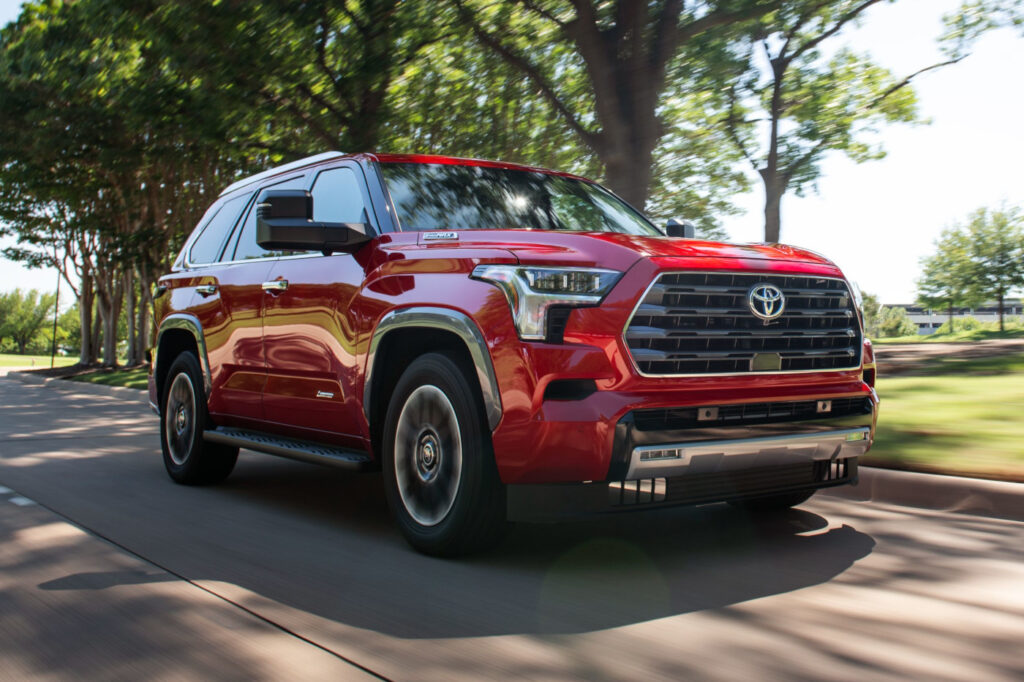
This is the 2026 Toyota Sequoia Capstone—an SUV that seems to have had a bit of an identity crisis. On the one hand, it’s a rugged, body-on-frame Toyota built to tow mountains and survive the apocalypse… and on the other, it’s dripping in chrome, stuffed with leather, and desperately trying to convince you it belongs outside a five-star hotel. The question is—has Toyota accidentally built a bargain luxury SUV… or just an overpriced truck in a tuxedo? Let’s find out.
Top Trim
There are six trims for the 2026 Toyota Sequoia: SR5, Limited, Platinum, TRD Pro, 1794 Edition, and Capstone. The Capstone trim is a vehicle that answers a question absolutely no one asked, with the sort of confidence usually reserved for people who wear loafers without socks and call it “a lifestyle choice.” It’s the most expensive Toyota available in the US. It seamlessly combines high-end style, comfort, and functionality. Additionally, for individuals who are averse to technology and favor conventional controls above all else, it meets their needs as well.
Under the hood
Let’s begin with the engine, because Toyota clearly did. Under the hood sits a twin-turbocharged 3.4-liter V6, bolted to a hybrid system like a science experiment that got slightly out of hand. The result? 437 horsepower and 583 lb-ft of torque. Which is less “family SUV” and more “continental drift with cupholders.” Now… fuel economy. This is where the Toyota Sequoia clears its throat, looks slightly embarrassed, and changes the subject. Officially, it’ll tell you 19 mpg in the city, 22 on the highway, 20 combined. Which sounds acceptable. Sensible, even. Like it’s trying to convince you it’s been to finishing school. In reality? It drinks like it’s just come off a long shift in a northern pub.
On the highway, cruising along like a well-behaved SUV, I managed 21 mpg. Respectable. But the moment you venture into town, stop, start, traffic lights, the usual urban misery, it all falls apart rather spectacularly. I saw numbers closer to 15 mpg. Over a full week of mixed driving? A rather unimpressive 15.5mpg
And yes, it’s a hybrid. It can glide along silently on electric power… briefly. Very briefly. The second you even think about a hill—or dare to flex your right foot—the gas engine barges back in like an uninvited guest at a wedding. Which tells you everything you need to know. This hybrid system isn’t here to save polar bears. It’s here to shove a very large SUV down the road with surprising enthusiasm while fuel economy quietly slips out the back door.
Looks
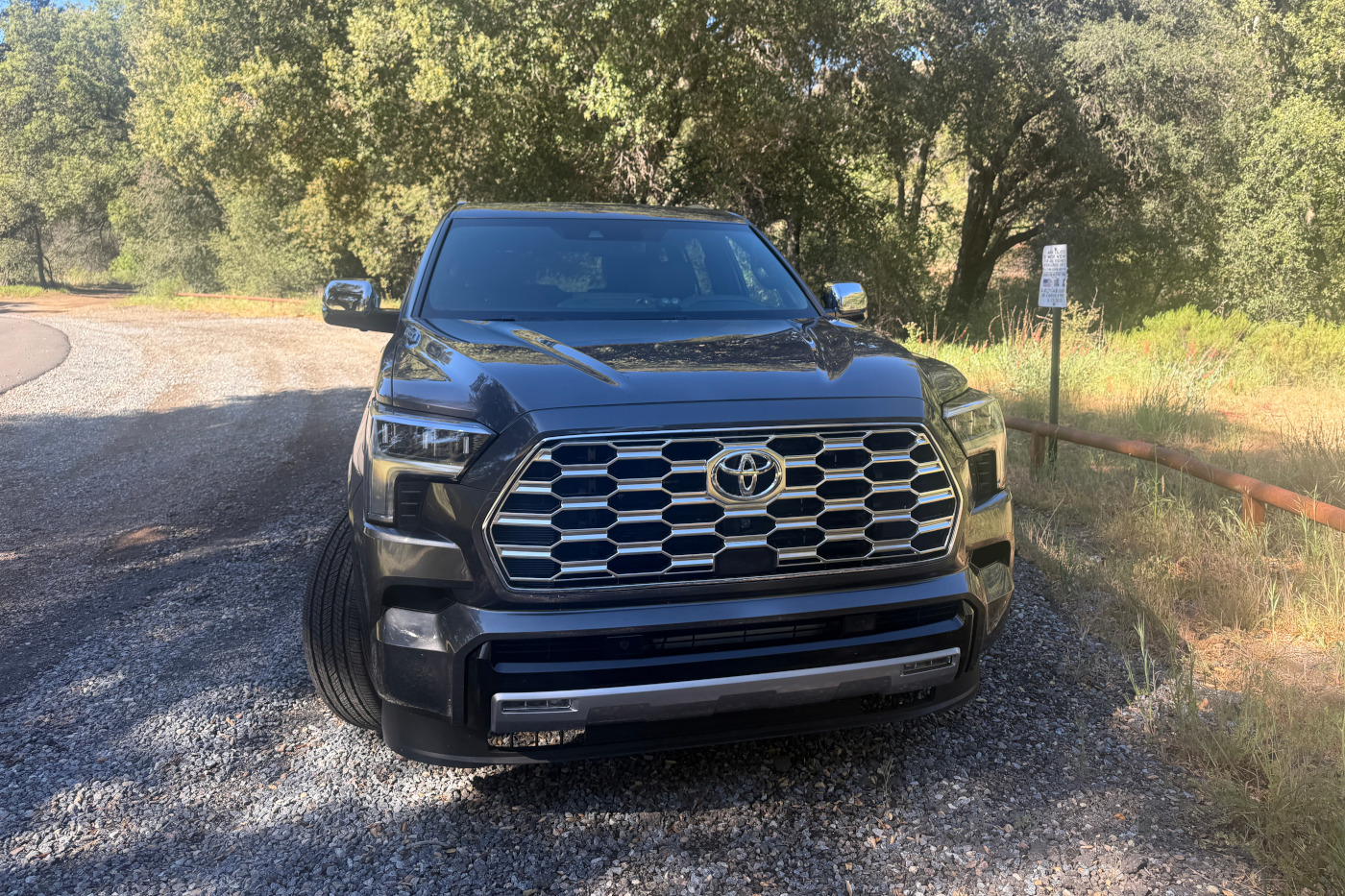
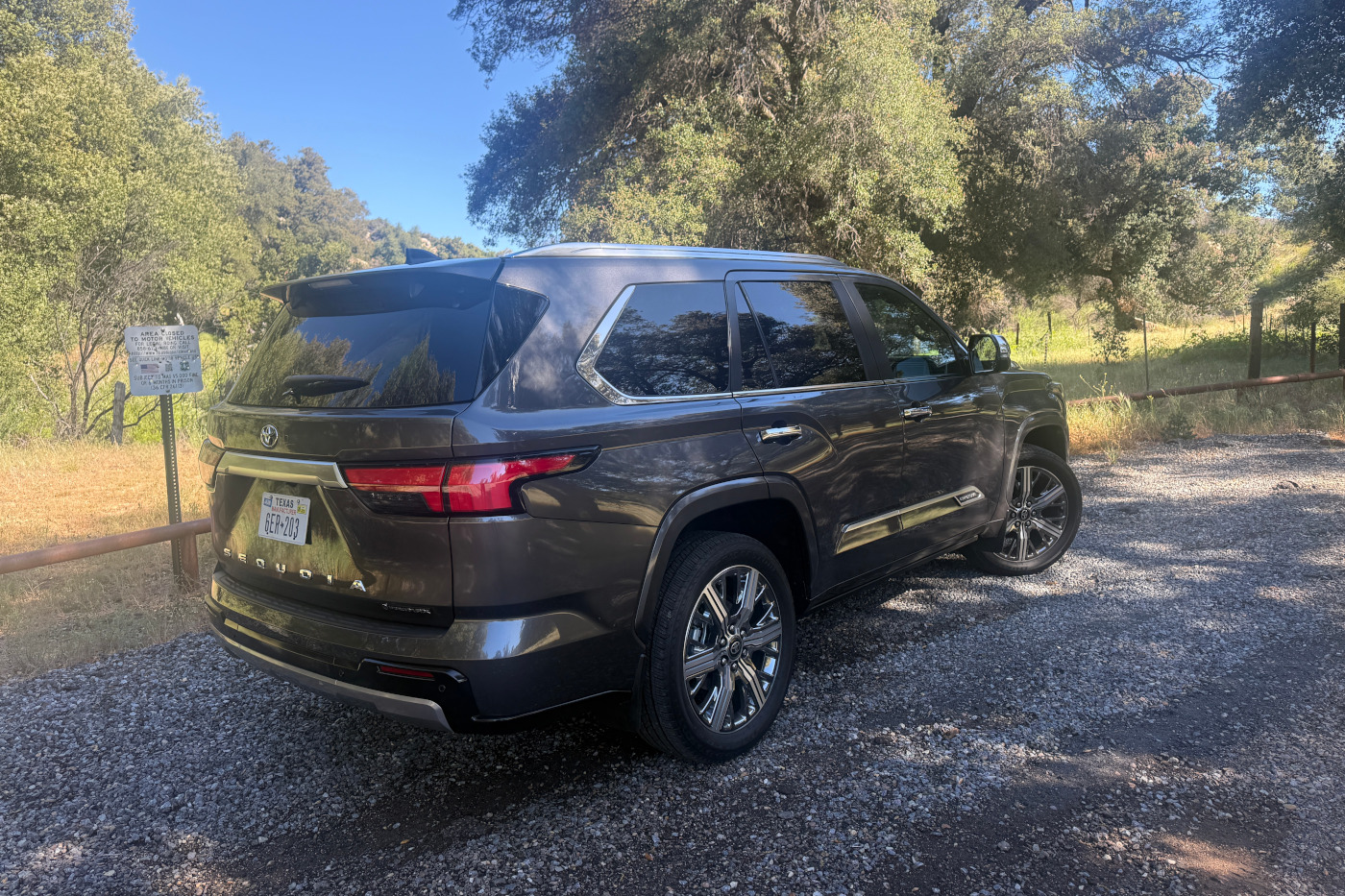
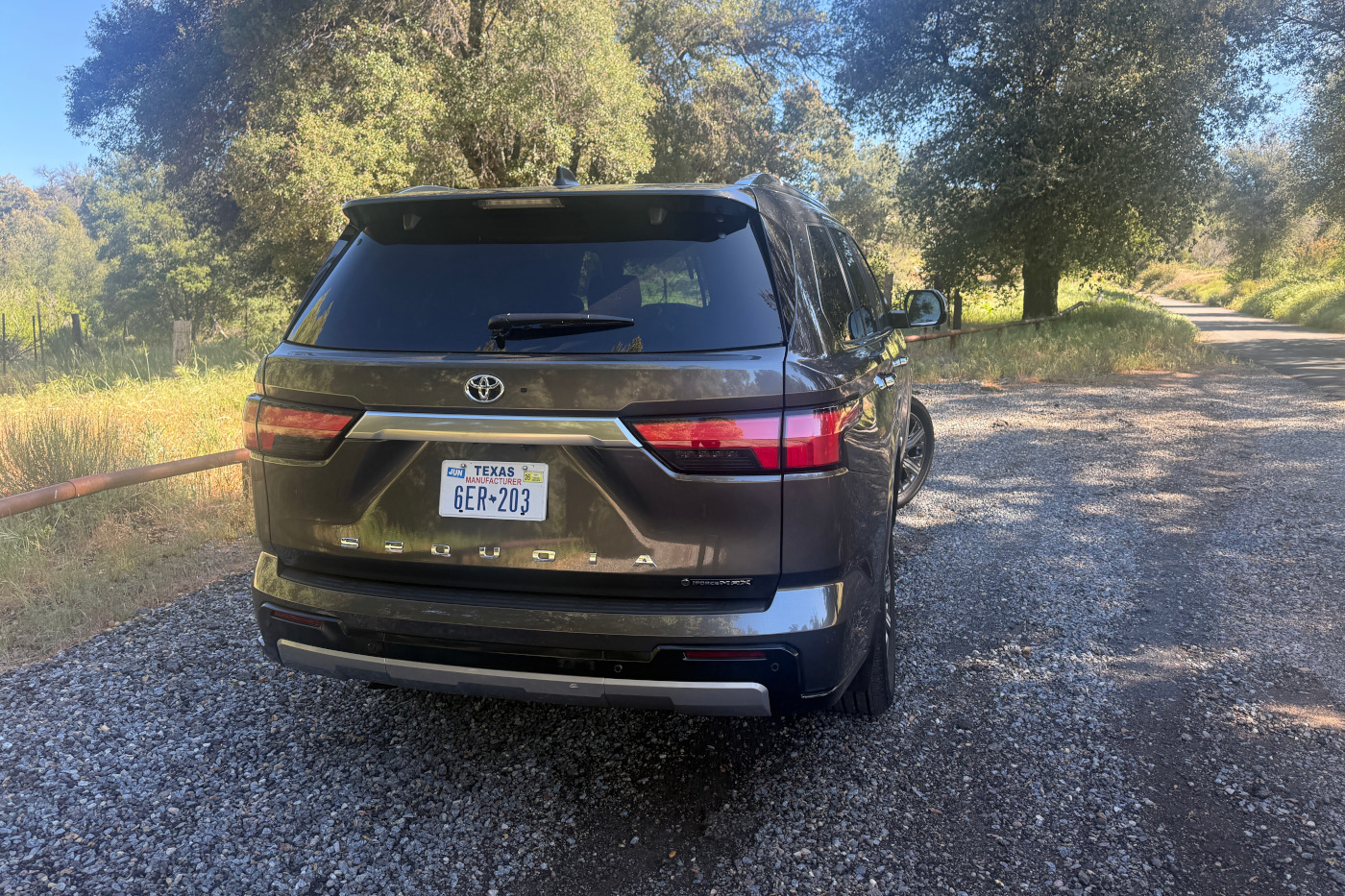
Now, visually, it’s… imposing. The grille is enormous, but not quite as large as its sibling, the Toyota Tundra, which looks like it eats smaller cars for breakfast. The Capstone, however, has been to a finishing school high in the Swiss Alps, there’s chrome, more chrome, and just when you think it’s enough chrome, Toyota adds a bit more, just to blind passing aircraft.
Wheels and Tires
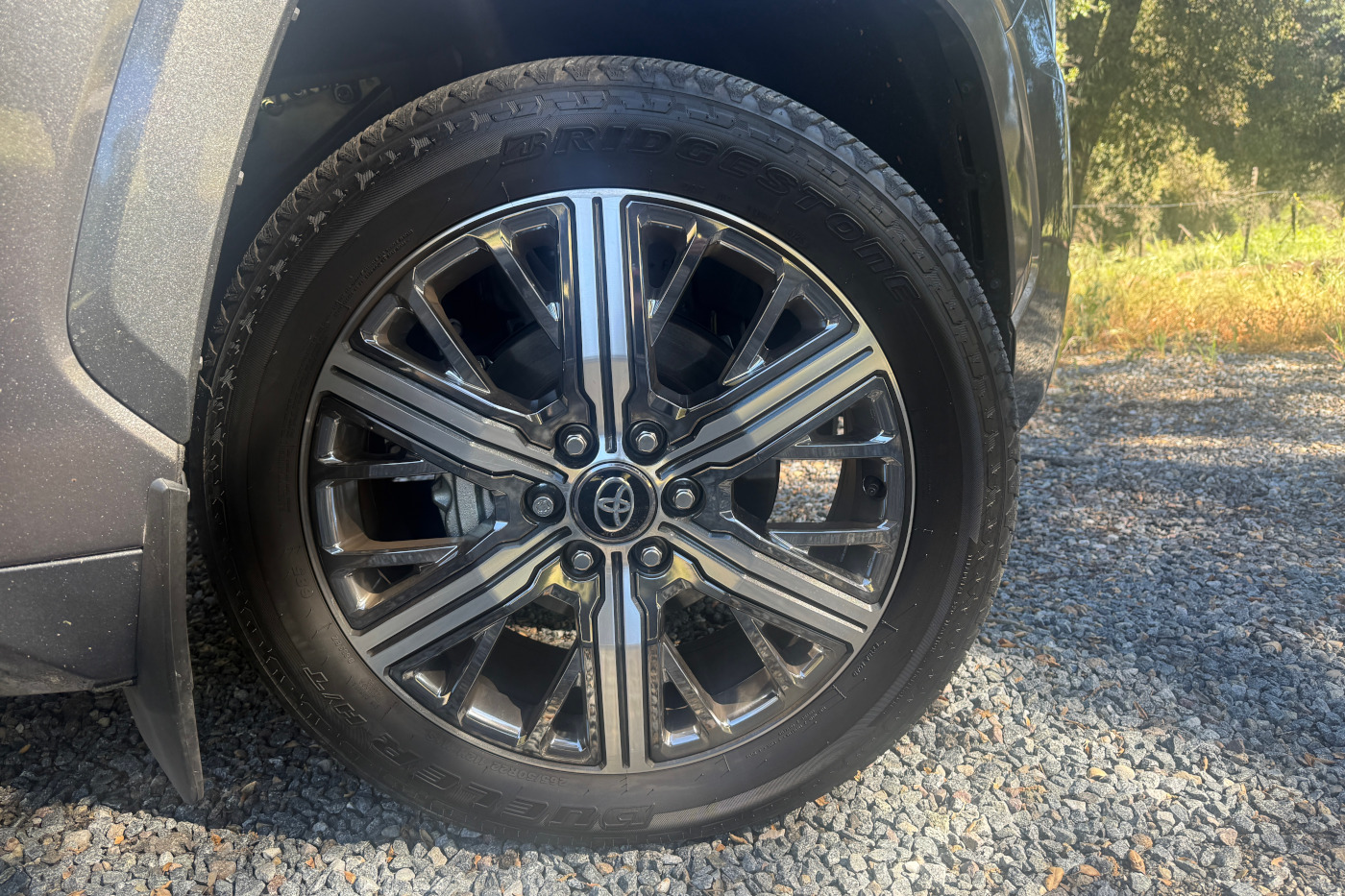
It rides on 22-inch Dark Chrome machine-finished alloy wheels, shod with 255/50 Bridgestone tires. It should have the ride quality of a shopping cart filled with bricks, but it’s actually pretty good. Credit here goes to the rear suspension and adaptive dampers, which somehow manage to disguise the fact that this is still a body-on-frame SUV with a solid rear axle, essentially agricultural machinery wearing a tuxedo.
Driving
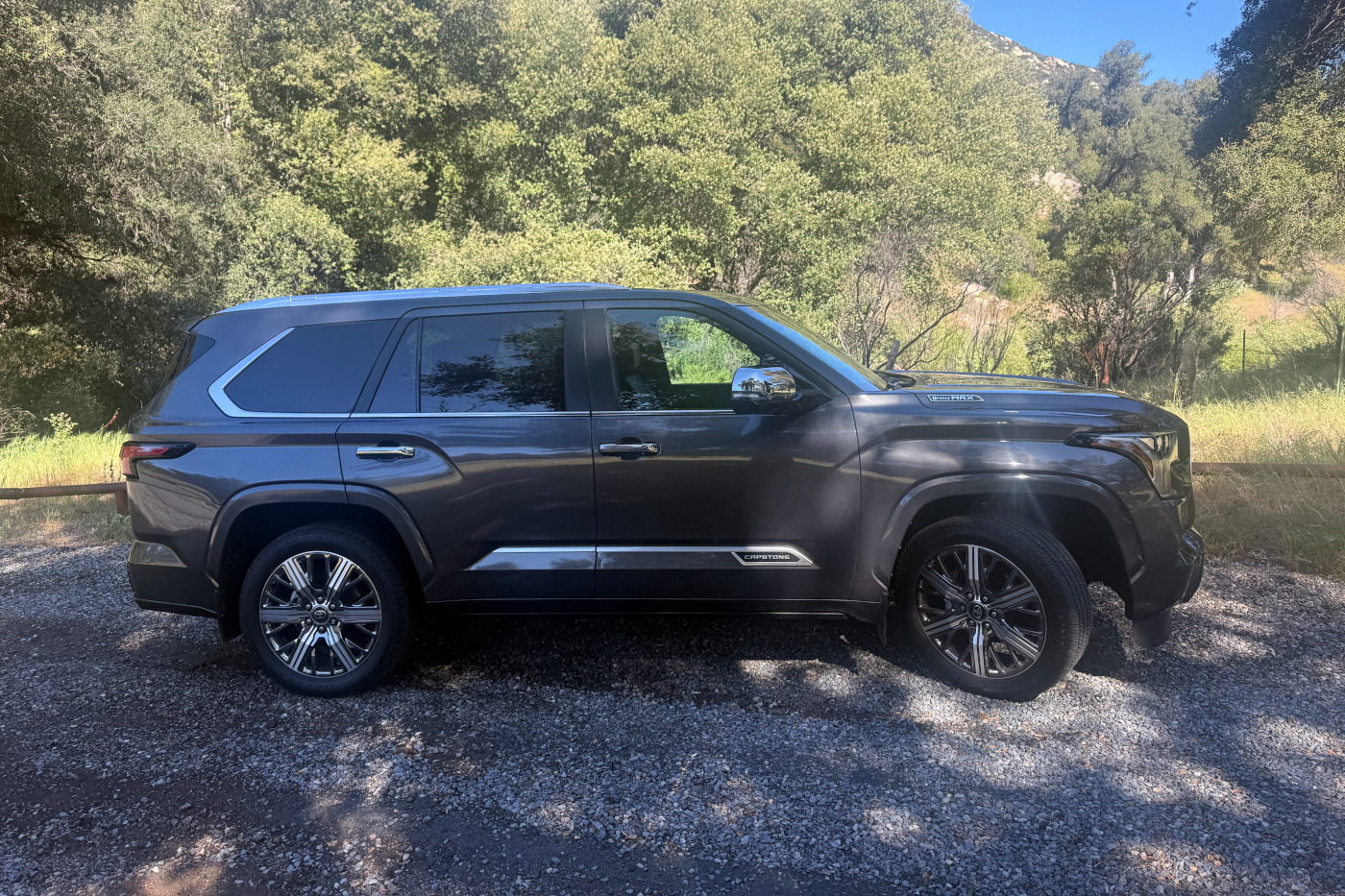
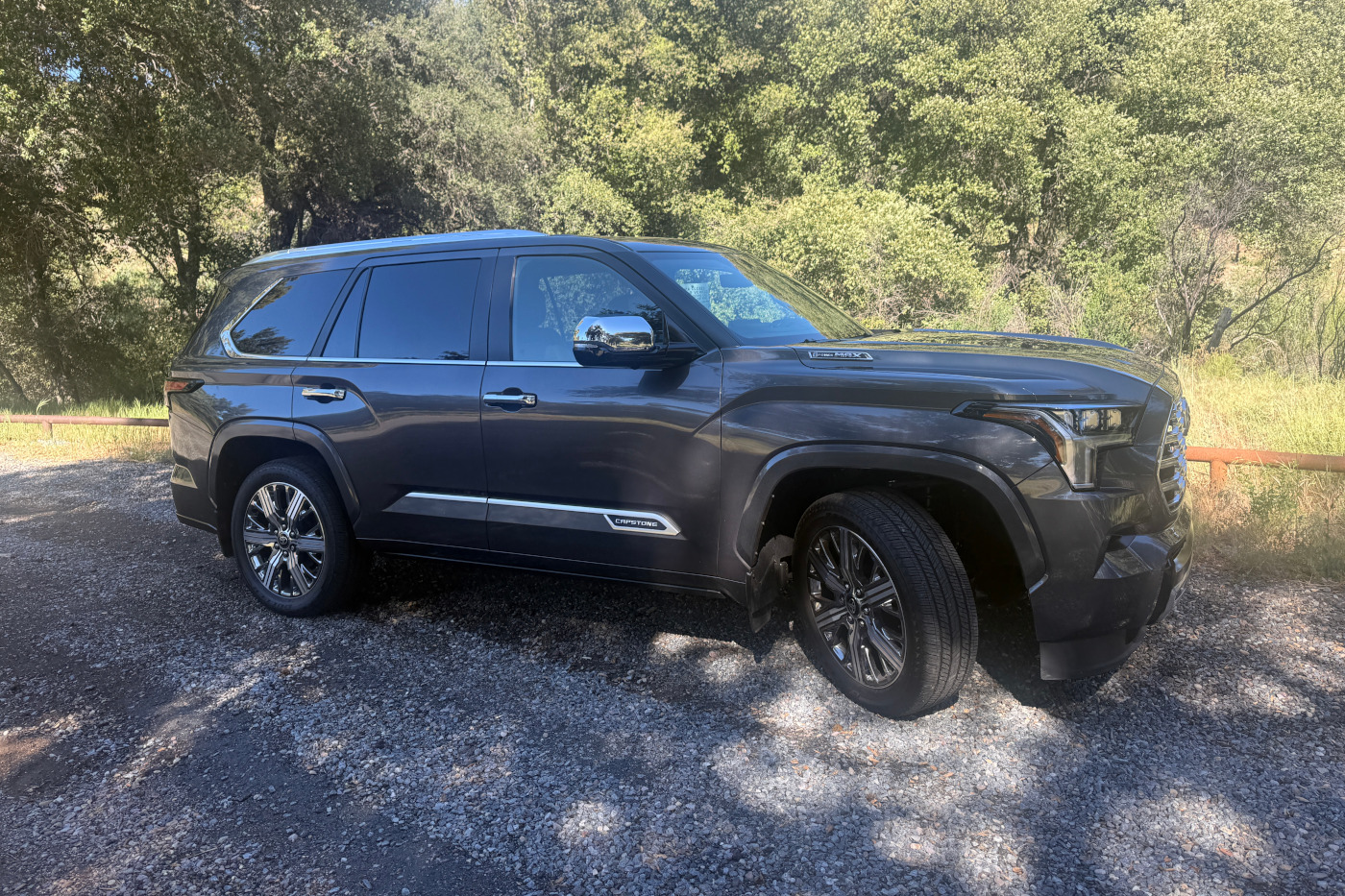
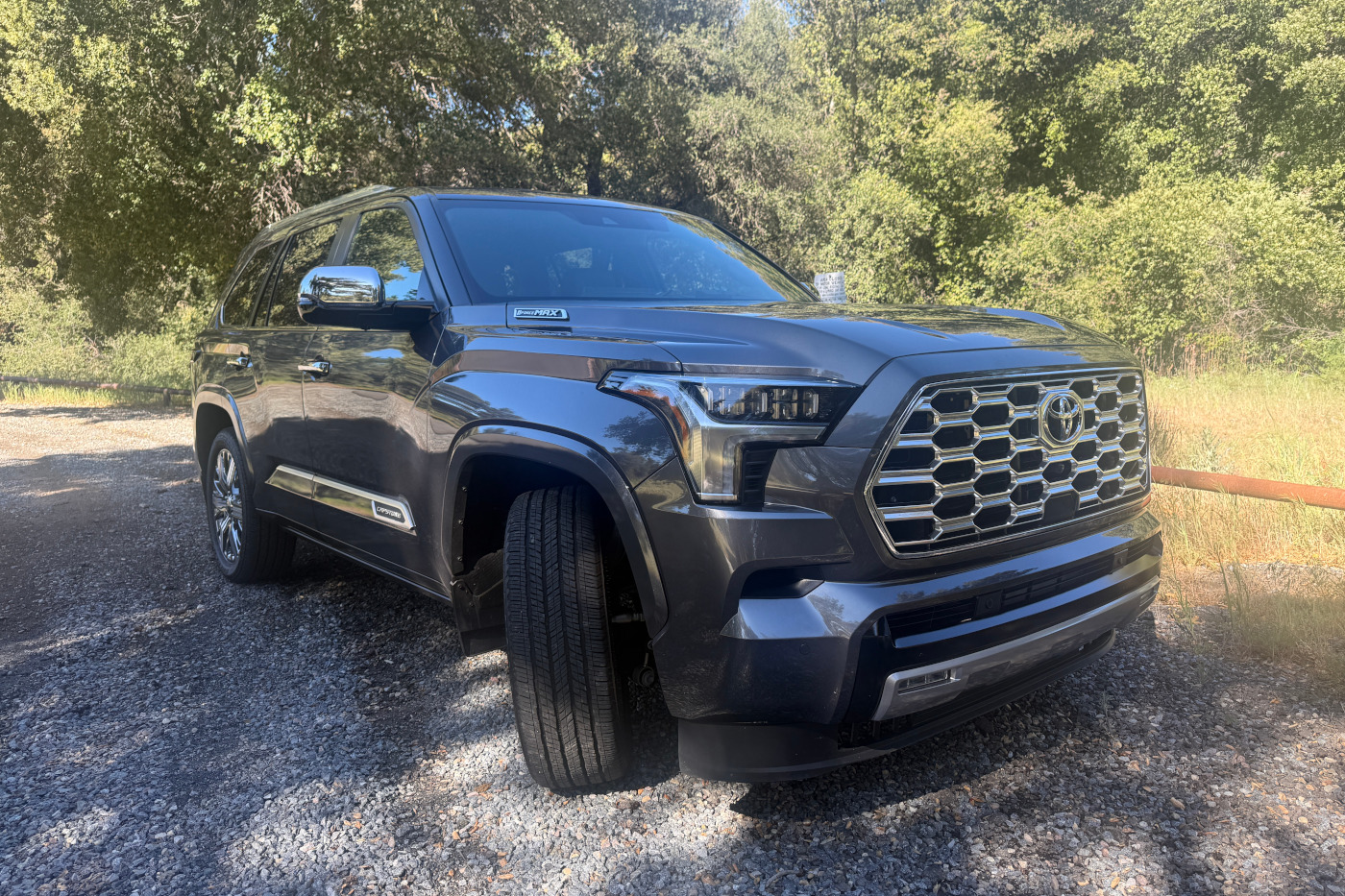
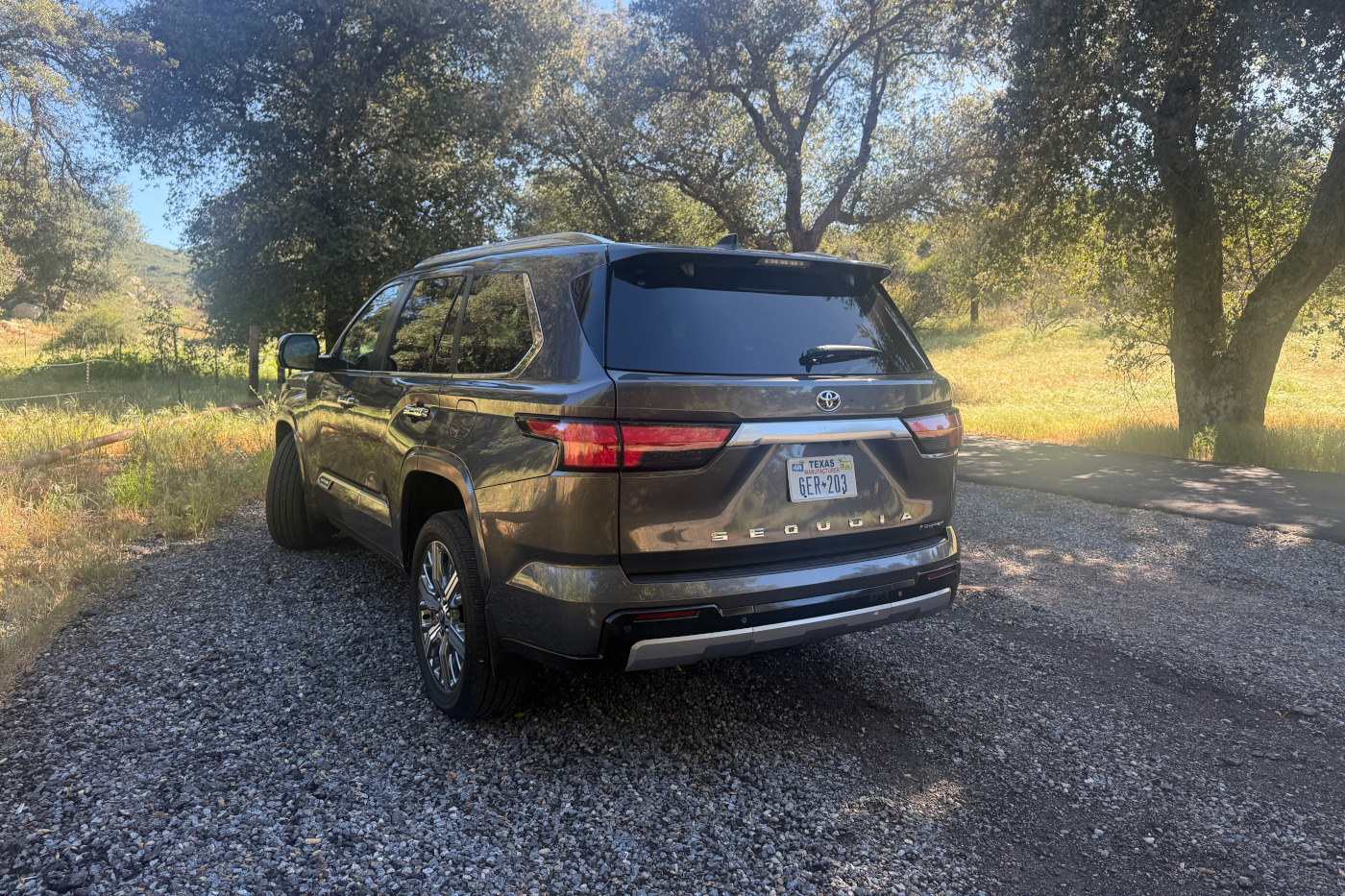
Out on the road, the Capstone reveals its split personality. The powertrain is… enthusiastic, it doesn’t try to pretend it’s an electric car. It just gives you torque immediately, violently, and slightly chaotically. It’s not smooth, but it is satisfying like using a sledgehammer to crack a walnut.
The Toyota Sequoia delivers its peak torque at just 2,400 rpm, which means the moment you prod the throttle, it gets on with things immediately. There’s none of that usual turbocharged hesitation—you know, the pause where you wonder if you’ve accidentally stalled it. Instead, the hybrid system gives it a proper shove off the line, like a bouncer ejecting someone from a nightclub.
And here’s the surprising bit: it doesn’t feel underpowered. At all. Despite weighing roughly the same as a small continent, it gathers speed with a sort of calm, muscular confidence. Smooth, strong, and entirely unbothered. The 10-speed automatic transmission helps too, slipping between gears with the kind of effortlessness you’d expect from something far smaller—and occasionally holding onto one like it actually knows what it’s doing. But then… You arrive at a corner, and suddenly, you remember exactly what you’re driving.
Because for all its cleverness in a straight line, this is still a massive, shipping-container-sized SUV. It feels wide—really wide—like you’re trying to thread a wardrobe down a country lane. Grip, however, is surprisingly good; it’ll hang on better than you expect. But there’s always that underlying sense that physics is watching closely, arms folded, waiting for you to get carried away.
Interior and Tech
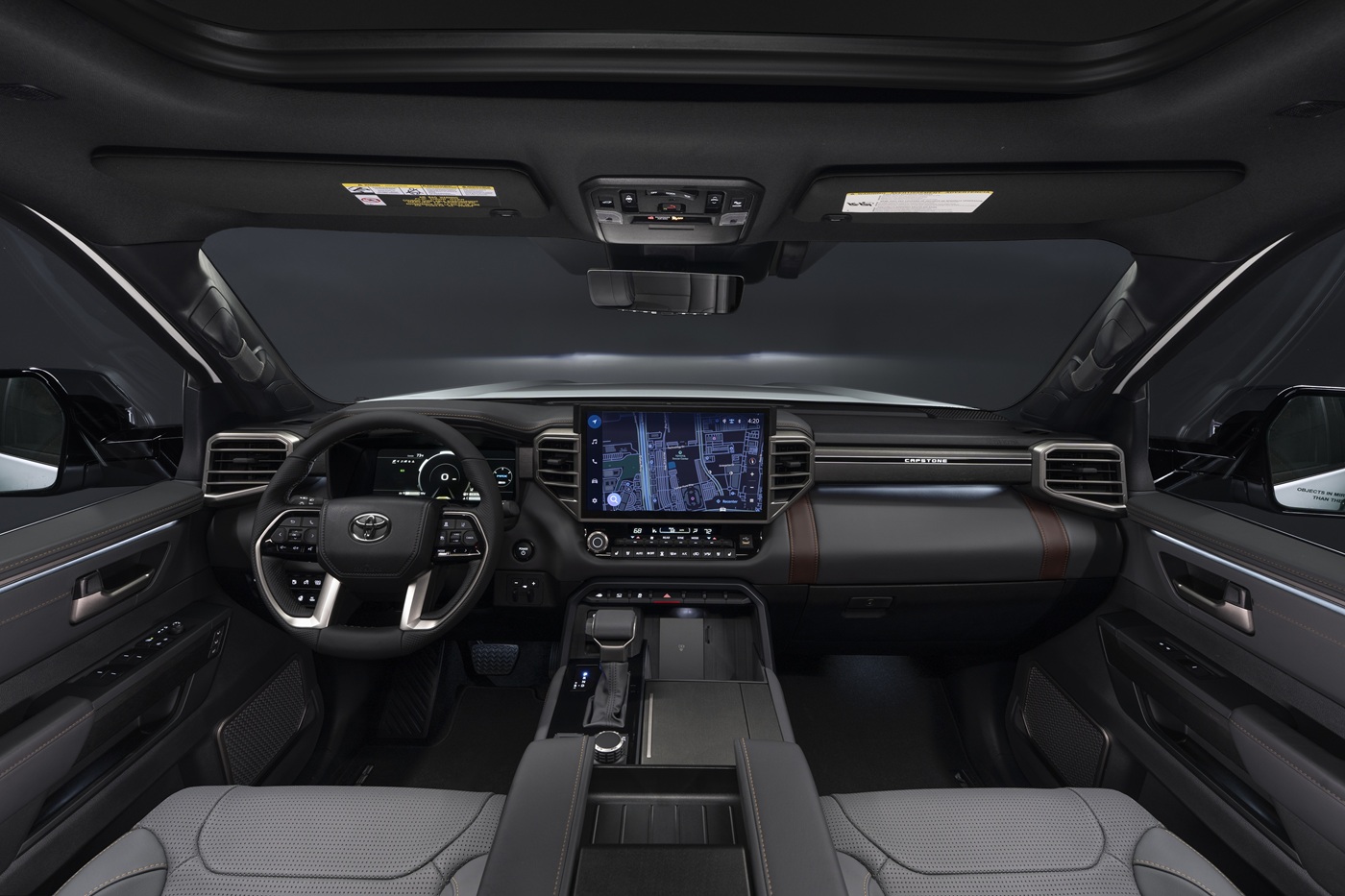
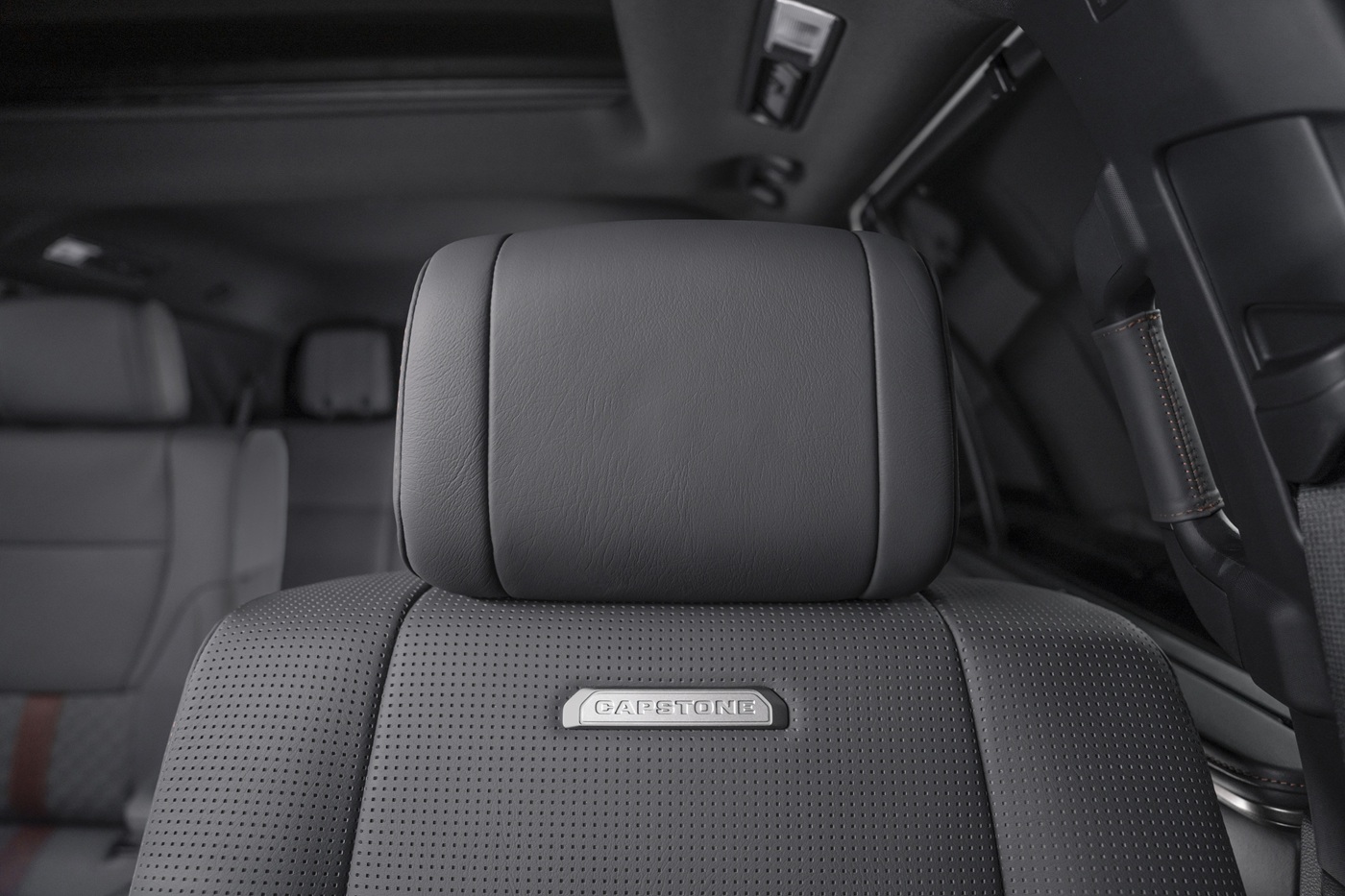
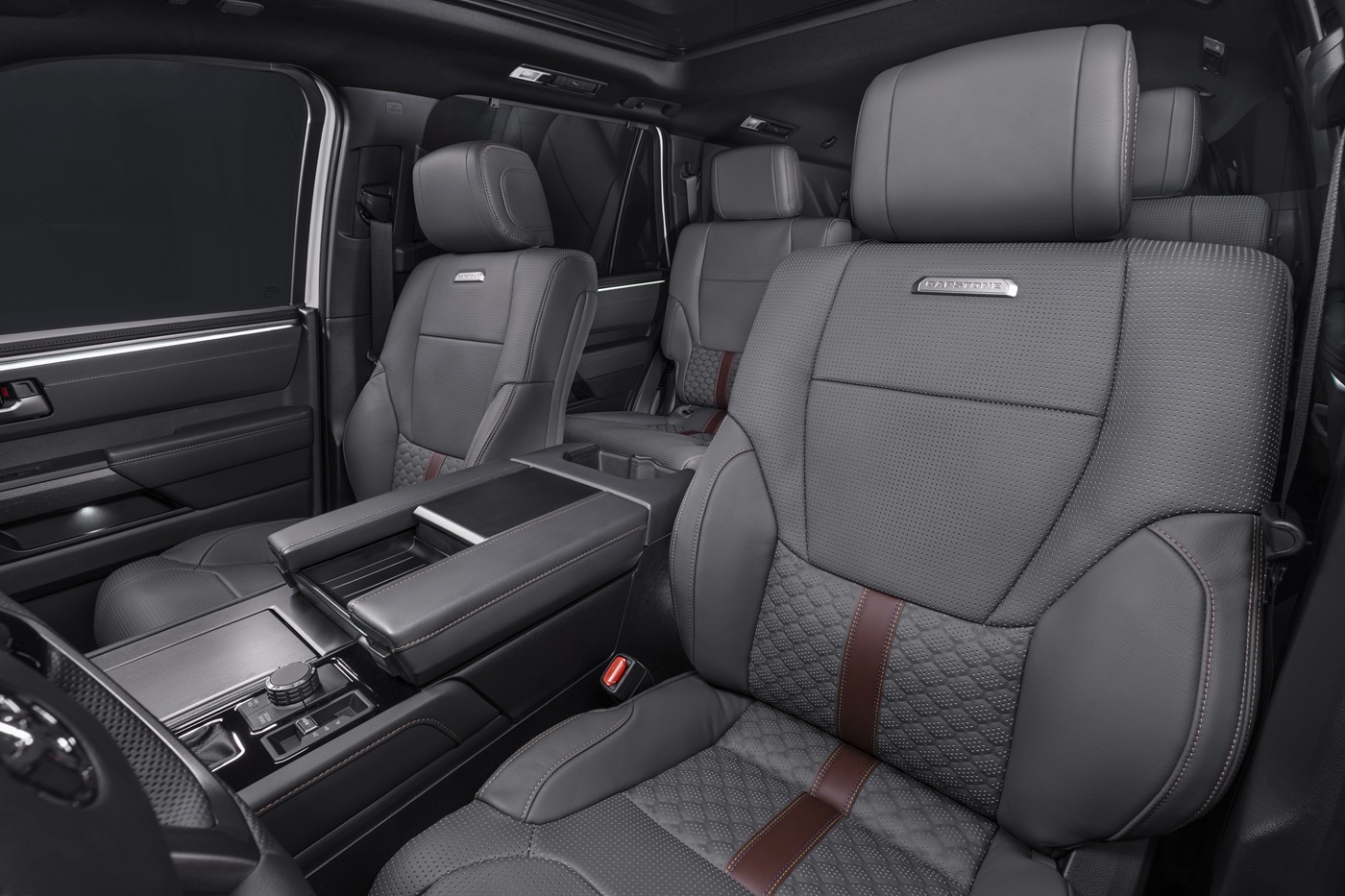
Inside, you’re greeted by leather everywhere, proper, thick, expensive-feeling leather, along with plush carpeting that suggests you should probably remove your shoes before getting in. There’s even dark American walnut trim, which is code for “someone in a boardroom said: make it posh.”
Then you notice the details. A glowing “CAPSTONE” badge on the passenger side, because apparently, you might forget what you bought. Metal speaker grilles that look like they belong in a high-end hi-fi shop. Even the door handles feel like they’ve been designed by someone who irons their socks.
But, and this is important, it hasn’t gone completely soft. Oh no. Because just when you think it’s turned into a rolling gentleman’s club, you grab the steering wheel and it’s thick. Properly chunky. Like it’s been bench pressing. The same goes for the gear shifter, which looks like it’s ready to tow a mountain. So yes, it’s luxurious. But it also constantly reminds you that if required, it could probably drag a small country out of a ditch.
The driving position is commanding, the steering wheel is nicely trimmed, and everything works with that reassuring Toyota “this will outlive you” solidity.
Now, let’s talk about screens. In the Capstone, you get a 12.3-inch digital driver display. And yes, it’s bright. It’s colourful. It’s also about as calm as a fruit machine in a seaside arcade. There’s so much going on, you half expect it to start dispensing coins. Frankly, a bit of simplicity wouldn’t go amiss—maybe fewer flashing graphics
Then there’s the big one in the middle: a 14-inch touchscreen paired with a 14-speaker JBL sound system. And this is where things take a surprising turn… because it’s actually quite easy to use. No digging through seventeen menus just to turn the fan down. No existential crisis every time you want to change a setting. It just… works. In fact, Toyota has done something rather rebellious here; they haven’t shoved every single function into the screen. Climate controls? Actual buttons. Real, physical things you can prod without taking your eyes off the road like a distracted meerkat.
Yes, the system itself is a bit simple by modern standards, and yes, there’s a newer, shinier version on the way. But honestly? With wireless Apple CarPlay and Android Auto doing most of the heavy lifting, you won’t really care because sometimes, in a world obsessed with overcomplicating everything… doing the obvious thing feels like a stroke of genius.
2nd and third row
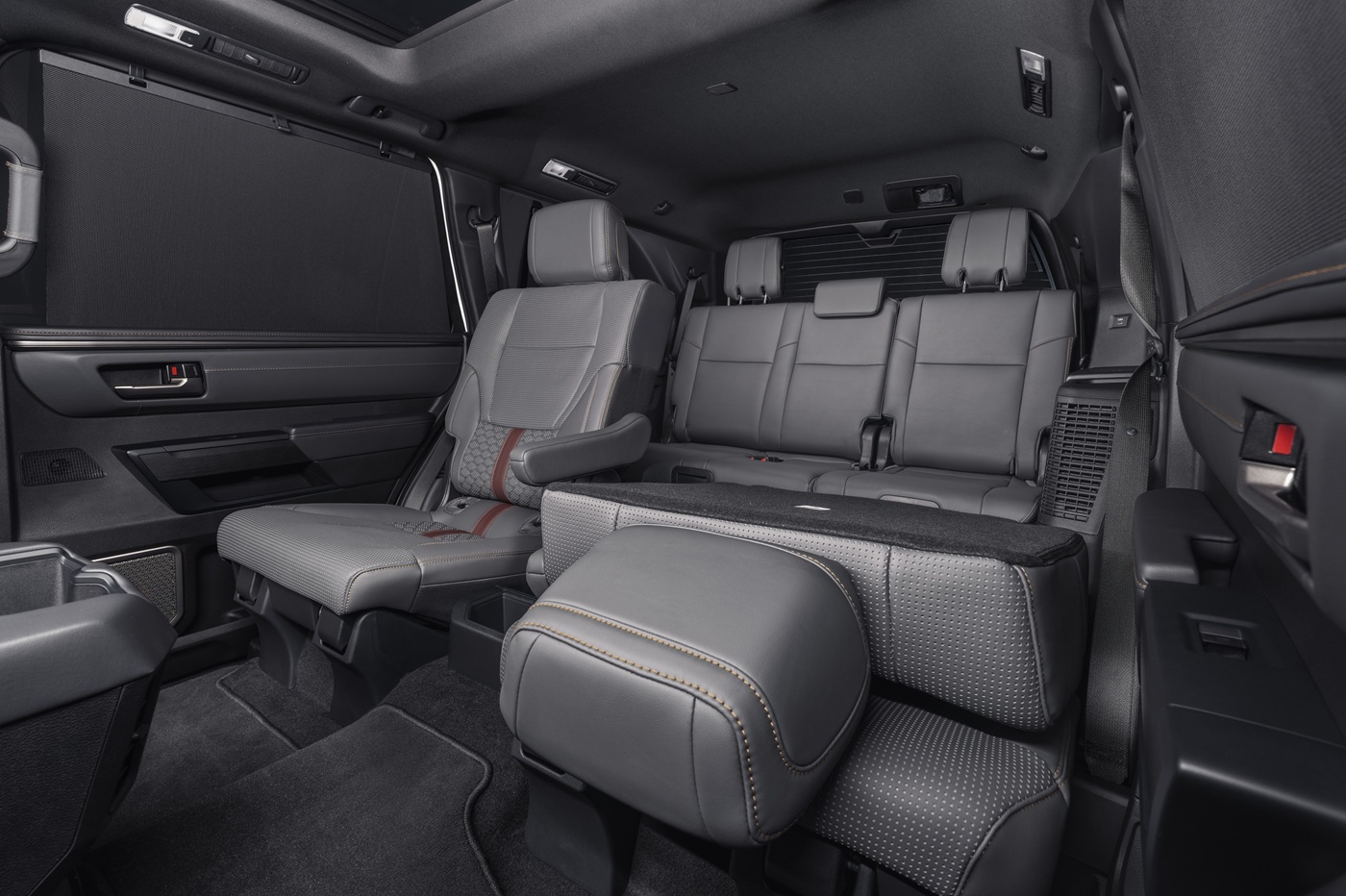
The second row is spacious enough to host a small dinner party. Heated seats, ventilated seats, climate zones, it’s all there. Then you climb into the third row, and suddenly, you’re in economy class on a budget airline. You see, the third row sits awkwardly atop the hybrid battery and rear axle, creating a sort of elevated perch that feels less like a seat and more like a punishment. Chances are you’ll never venture back there, but it will suffice for the kids.
Cargo Area
The 2026 Toyota Sequoia cargo area offers 11.5–22.3 cubic feet behind the third row (depending on seat sliding), 49 cubic feet with the third row folded, and 86.9 cubic feet maximum. Due to the hybrid battery, the third row does not fold flat, requiring a multi-level adjustable shelf system to create a level load floor.
Price
This is the elephant in the room. At nearly $90,000, this thing is priced like a luxury SUV, dressed like a luxury SUV, and behaves like a luxury SUV. Yet it wears a Toyota badge, as if it’s slightly embarrassed about the whole affair. The base price on this one is $84,435. It has a couple of options including wheel locks, cargo mats and various subscriptions, which take the total price to $87,347.
Here’s the problem: the Capstone exists in a strange no-man’s land. It’s too expensive to be a sensible Toyota and not quite prestigious enough to be a proper luxury car. It’s the automotive equivalent of a tuxedo T-shirt—technically fancy, but no one’s entirely convinced.
VIDEO REVIEW
Verdict
So, in conclusion: the Sequoia Capstone is brilliant… but also slightly pointless. If you want rugged capability, buy the TRD Pro. If you want luxury, buy a Lexus. And if you want something that sits awkwardly in between, wearing chrome like costume jewelry at a royal wedding… Well. Toyota has just the thing.
2026 Toyota Sequoia Capstone Numbers
BASE PRICE: $84,435
PRICE AS TESTED: $87,348
VEHICLE LAYOUT: Front engine, all-wheel-drive, 7-passenger, 4-door SUV
ENGINE: 3.4L Twin-turbo DOHC 24-valve V-6, plus front electric motor
POWER: 389 hp @ 5,200 rpm (gas), 48 hp (elec); 437 hp (comb)
TORQUE: 479 lb-ft @ 2,400 rpm (gas), 184 lb-ft (elec); 583 lb-ft (comb)
TRANSMISSION: 10-speed auto
0-60 MPH: 5.9 seconds
CURB WEIGHT: 6,100 lb
CARGO VOLUME: 22.3 ft³ behind 3rd row, 49.0 ft³ behind 2nd row, 86.9 ft³ all seats folded
FUEL ECONOMY Combined/city/highway: 20/19/22 mpg
OUR OBSERVED: 15.5 mpg
PROS: Great looking, more modern interior, more efficient, surprisingly quick
CONS: Compromised cargo space, Cramped third row, Capstone is expensive.
2026 Toyota Sequoia Capstone Review
