
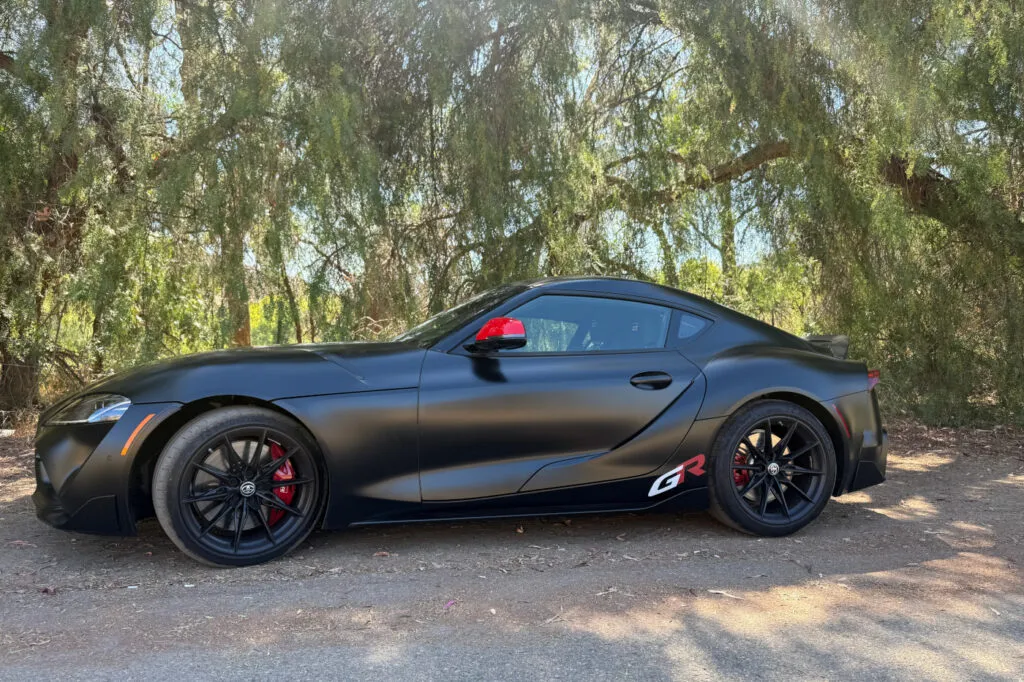
The Supra is a car that spent seven years being accused by internet commentators of not being a real Toyota because it was developed alongside BMW and stuffed full of German bits. According to these keyboard warriors, it was essentially a BMW Z4 wearing a fake moustache and speaking Japanese with a Bavarian accent. And yet… It’s brilliant.
Over the past seven years, this peculiar Japanese German science experiment has become one of the most entertaining sports cars on sale. We’ve flogged it around racetracks, hurled it through corners, abused it mercilessly, and every single time it’s responded by asking for more. Now, sadly, it’s all coming to an end. The MkV Supra is taking its final bow after 2026, and Toyota has marked the occasion with what it’s calling the Final Edition. Which, in automotive marketing speak, means “it costs more.” Thankfully, Toyota has done more than just raid the accessory catalogue.
What’s new?
The 2026 Toyota Supra Final Edition receives larger front brakes, stiffer suspension components, revised steering, recalibrated electronics, more aggressive suspension geometry, and additional chassis bracing. In other words, the engineers have spent the last few years obsessively tweaking every nut, bolt, and electronic wizard under the skin. The result? A Supra that feels sharper, more alert, and more eager than ever.
Interestingly, nobody complained when Lotus used Toyota engines. Nobody complains when Aston Martin borrows Mercedes-AMG V8s. And nobody should complain here because this engine is magnificent. It delivers smooth, relentless thrust accompanied by the sort of silky soundtrack that only a straight-six can provide.
Under the hood
Is the excellent twin-turbo 3.0-liter inline-six and its 382 horsepower and 368 lb-ft of torque. It’s driven through a 6-speed manual transmission. Expect 0-60 in around 4 seconds.
Driving


The truly baffling thing about the Supra is that it’s managed to out-BMW the BMW it’s built from. On paper, it should be impossible. It’s like discovering the supermarket’s own-brand baked beans are somehow better than Heinz. Yet here we are.
Yes, underneath it’s essentially a BMW Z4 wearing a Toyota badge, but somewhere along the way Toyota engineers clearly locked the Germans out of the workshop and got on with making it properly entertaining.
The fixed roof helps too. Instead of wobbling about like an overcooked trifle every time you attack a corner, the Supra feels solid, eager, and wonderfully alive. Then there’s the straight-six under the bonnet. Purists may grumble that it came from Munich rather than Aichi, but frankly, who cares? It’s smooth, gloriously punchy, and exactly the sort of engine a Supra deserves. The badge on the rocker cover matters far less than the grin plastered across your face every time you flatten the throttle.
The manual gearbox transforms the Supra from a very fast sports car into something you actually want to have a relationship with. Modern automatics are astonishingly clever. They’ll change gear faster than a caffeinated octopus solving a Rubik’s Cube. But that’s rather the problem. They do all the thinking, leaving you with little more to do than point at the horizon and hope the speed cameras are asleep.
The manual changes everything. Suddenly, every corner is a decision instead of an event. You find yourself chasing the perfect downshift, timing each upshift like you’re conducting an orchestra with your left foot and right hand. It’s gloriously involving. Yes, it’s slower on paper. Somewhere, a spreadsheet is crying because the 0–60 time has grown by a few tenths. Who cares? Nobody has ever staggered out of a car grinning like an idiot because it shaved 0.2 seconds off a sprint to highway speeds. They grin because they were part of the process.
The result isn’t just a Supra with three pedals. It’s the Supra as it was always meant to be: noisy, mechanical, slightly demanding, and infinitely more rewarding. In an age where every performance car seems desperate to drive itself, the manual Supra has the audacity to insist that you do the driving instead. And what a wonderfully rebellious idea that is.
Interior


Toyota had to perform a bit of engineering gymnastics to squeeze a manual gearbox into the Supra. The center console has been reworked so the gear lever sits slightly farther back than the automatic selector, which meant relocating the parking brake switch, iDrive controller, and various buttons to somewhere less likely to become collateral damage. It’s not exactly a masterclass in interior feng shui, but your knuckles will be grateful. Without the changes, every enthusiastic shift into third would risk introducing your hand to the climate controls with all the subtlety of a pub brawl.
There is, however, one remaining hazard. The cupholders sit beneath the center’s armrest, and anything larger than a modest bottle of water becomes a potential obstacle during spirited driving. Forget the American-sized Big Gulp. If you’re rowing your own gears, hydration will need to be conducted with military precision.
Everything else is gloriously BMW, which in this case is no bad thing whatsoever. The materials are excellent, the controls are exactly where your hands expect them to be, and the whole cabin feels as though it was designed by people who actually drive cars rather than merely conduct focus groups about them. The only real drawback is space. The door sills are wider than those in some European countries, and larger occupants may find climbing in and out requires the flexibility of a gymnast and the determination of a mountaineer. At least there’s a wireless charging pad, because modern civilization would apparently collapse if your phone went below 37 percent of its battery.
The seats strike a pleasing balance between comfort and support. They’re a little firm, but that’s rather like complaining that a racehorse isn’t as comfortable as a sofa. Multi-way power adjustment and adjustable side bolsters hold you securely in place, making it easy to find the perfect driving position, whether you’re attacking a canyon road or simply pretending you are on the morning commute.
Visibility, meanwhile, is about what you’d expect from a car that looks like it was designed in a wind tunnel by people who hate windows. Looking over your shoulder requires a degree of faith, so you’ll quickly learn to trust the mirrors and the blind-spot monitoring system, which comes bundled in Toyota’s $1,195 Driver Assist Package, which may well save you from accidentally merging into a Prius.
The infotainment system is refreshingly straightforward, a rare achievement in an age where some cars require a software engineering degree just to adjust the temperature. My 3.0 Premium tester came loaded with heated leather seats, a head-up display, an 8.8-inch touchscreen, and a 12-speaker audio system. In other words, all the toys you need to enjoy the drive, and enough stereo power to drown out your passenger’s complaints about your driving.
Wheels and tires
These are Final Edition-specific 19-inch wheels wrapped in Michelin Pilot Super Sport tires. 255/35 on the front and 275/30s at the back. Larger 14.7-inch front brake rotors replace the standard 13.7-inch stoppers, and they work great in a car that weighs around 3,400 lbs.
Cargo Space
The Supra isn’t interested in helping you move house. It’s interested in helping you arrive at the next corner with a grin so wide it looks medically concerning. Which is why it only has 10.2 cubic feet of cargo space. That’s enough room for a weekend’s luggage, or a camera bag.
Price
Since this one is limited to 1300 units, it isn’t what you would call cheap. This one has a base price of $68,550, but it has a couple of options. The Driver Assist package is $1,195 and includes a Blind Spot monitor, Rear Cross Traffic Alert, and parking sensors with alert.
It also has the GT4 Style Pack for $2,160, which includes a matte-finish carbon fiber ducktail spoiler, front wheel arch flaps, and higher front tire spats to increase downforce and balance. Angled GR graphics on the rear quarter panels, glossy red carbon fiber mirror caps, and a matte black “Supra” rear badge. The GT4 Style Pack is exclusively paired with this Undercover (matte black) paint. Total Price is $73,210.
VIDEO REVIEW
VERDICT
Rumors suggest the next-generation Supra will be entirely Toyota-developed, which sounds promising. But it may also ditch the straight-six in favor of a hybrid four-cylinder setup. Faster? Probably. More efficient? Certainly. More exciting? That’s another matter entirely.
2026 Toyota Supra Final Edition Numbers
BASE PRICE: $59,400
PRICE AS TESTED: $61,840
VEHICLE TYPE: Front-engine, rear-wheel-drive, 2-passenger, 2-door hatchback
ENGINE TYPE: Turbocharged and inter-cooled DOHC inline-6
POWER: 382 hp @ 6500 rpm
TORQUE: 365 lb-ft @ 1600 rpm
TRANSMISSION: 8-speed automatic with manual shifting mode
CURB WEIGHT: 3,397 lb
ZERO to 60 mph: 3.7 sec
TOP SPEED: 155 mph
TIRES: Michelin Pilot Super Sport, Front: 255/35 ZR-19, Rear: 275/35 ZR-19
EPA FUEL ECONOMY: Combined/city/highway 26/23/31
OUR OBSERVED: 17.1 mpg
PROS: Scintillating handling, fantastic crackling exhaust, superbly quick
CONS: Very snug inside, limited storage
2026 Toyota Supra Final Edition Review
